Building balanced salad/nourish bowls
I think it is fair to say many people in eating disorder recovery fall into the trap of losing awareness of portion sizes, and have poor judgement in estimating what is enough for the body for its rehabilitation. Online we may see many influencers consuming colourful, appetising bowls of salad. And yes, they look appealing, vibrant and fresh and colourful, but how can we eat salads, whilst managing to physically restore our bodies.
A nourish bowl cannot be just a bowl full of dry, fresh vegetables. Firstly, this will simply not contain enough calories to be called a meal. Raw vegetables contain lots of water, and lack calories and energy density. Also, from vegetables alone, you will not be consuming enough protein and fats for a balanced plate. On average 100g of raw veggies contain 2-3g of protein (2-3%) and 0.5g of fat. Of course there are exceptions, however as you can see, not only will your energy intake suffer from eating a salad forlunch, but your macronutrient consumption will also be completely off balance.
That is why I want to share my advice and give examples of elements you can add to your nourish bowls, to not only eat a delicious tasty meal, but to also ensure it contains all the nutrients necessary to fuel you throughout the day and help you during both your physical and mental rehabilitation.
In order for your bowl to be balanced, yes you can have vegetables, which would comprise some of the carbohydrate intake, but you should also focus on including starchy carbohydrates, and sources of fat and protein to it.
Let’s begin with the base of the salad, the part which may take up the most volume, and can be composed of various different carbohydrates to add texture and ENERGY to your salad.
Whole grains, including quinoa, brown rice, barley, giant couscous etc.
Starchy vegetables: Roasted baby potatoes, sweet potatoes, butternut squash, pumpkin
Leafy greens: Spinach, kale, rocket or mixed greens (if choosing this, you’ll need to balance the bowl out with other ingredients which are higher in density, or have two different bases to ensure you are not filling yourself up with high volume and water content, low calorie density leaves)
A second element to your bowl, should be a source of protein. The incorporation of high quality proteins to every meal, sustains your satiety, can boost metabolism and aids in muscle growth and tissue recover. In eating disorder recovery it is vital to consume enough protein to repair all the muscle which has may have been broken down due to long periods of malnutrition. Your organs may have suffered because of food intake restriction, the amino acids within proteins act as building blocks to rebuild the broken down muscles, reverse the internal organ damage and to strengthen hair and nails. Not only this but the immune system also receives a boost. Protein helps in restoring immune cells, strengthening our resilience against infection, reducing our vulnerability to general sickness. Below a few examples are listed on how you can incorporate this macronutrient into a salad. I often combine various plant based and non-vegan protein sources to add variation to my salad bowls:
Grilled chicken breast, turkey or salmon
Cooked prawns, tuna, hot smoked fish (salmon, trout etc.)
Crispy oven baked or air-fried chickpeas
Edamame beans, green peas, lentils, black beans
Tofu, tempeh
Hard boiled eggs
A third addition must be a source of healthy fats. Fats will add lots of flavour to your bowl, as well as optimising the nutrients we take in from the vegetables. Even though your eating disorder may disagree, a bowl full of vegetables isn’t all that tasty and satisfying on its own. Fats bring richness to food, which can be scientifically proven as they act as flavour carriers. They act as vehicles, dissolving and carrying flavour compounds, especially from the likes of spices and herbs we add to dishes. These are released slowly as we consume foods. Aside from aiding physical recovery due to their energy density supporting weight gain, fats are necessary for sufficient brain functioning. Neural regeneration is needed as we recovery. Otherwise we will continuously follow our old habits and patterns our eating disorder voice has made us believe we must listen to. In order to break free from our destructive ways, we need to rewire and challenge the beliefs of our eating disorder, which cannot be done if our diet is lacking in healthy fats, and vital fatty acids. Therefore I cannot stress enough how we should stop fearing fats, as that is yet another thought which is only driven by the monster that has taken over from the reality of our nutrition. Tasty, and nutritious fat sources to be added are:
Avocado slices, or guacamole/green goddess dressing
Hummus, or a drizzle of tahini or nut butter (can also add to dressing)
Chopped up nuts (almonds, cashews, pistachios etc.) or a sprinkle of seeds (flax seeds, hemp seeds, pumpkin seeds)
Use olive oil to drizzle on your greens, or to roast starchy vegetables in
Also, acting as a protein, eggs and oily fish are both great sources of fatty acids too
Now that all the crucial components have been mentioned, it is now time to add colour and freshness to your bowl, with any additional vegetables, or pickled ingredients you may like. Below are a list of my favourites:
Sweet vine ripened cherry tomatoes, cucumber moons, carrot ribbons
Chunks of mango, pineapple or pomegranate seeds to add sweetness
Tenderstem broccoli, roasted broccoli or cauliflower, shredded kale
Pickled red onion, beetroot or sauerkraut to add zing
Feta or mozzarella cheese
Green or black pitted olives, capers
One thing which is a MUST for any salad, is some kind of dressing or sauce. Throughout my eating disorder I convinced myself that I simply did not like, or even hated salads with any kind of dressing. I myself was fully under the influence, that I despised soggy vegetables, and led others to believe that I actually enjoyed dry, tasteless salad leaves. During my recovery, I have realised what a mistake it was to not add something to dress my nourish bowls with, without any flavour your bowl will be bland. And, if you truly think that it is an unnnecessary element, I have to suggest that that is something that the eating disorder voice is telling you. A dressing is an easy part to skip. You may be eating a full plate of food, but deep down you know that others will see you eating a decent sized portion, without contemplating the fact that all the calories are lost without this missing component. A dressing doesn’t have to be complicated, a few ingredients combined can create a delicious saucy element to add to your bowls:
Green goddess dressing made by blitzing avocados, lemon juice, fresh herbs, and greek yoghurt
Honey mustard salad dressing
Jalapeño brine, lime juice, maple and dijon, for spicy, sweet and sour kick
Tahini, garlic, lemon dressing
Asian inspired peanut butter, soy sauce, rice vinegar sauce
Miso, maple and ginger dressing
Citrus zingy basil dressing (using combination of orange and lime or lemon juice)
Lastly, if you want to add extra flavour boosts to your bowl, add fresh herbs like coriander or parsley, or if you can handle the spice, sliced chillies pair well with nourish bowls with Asian influences
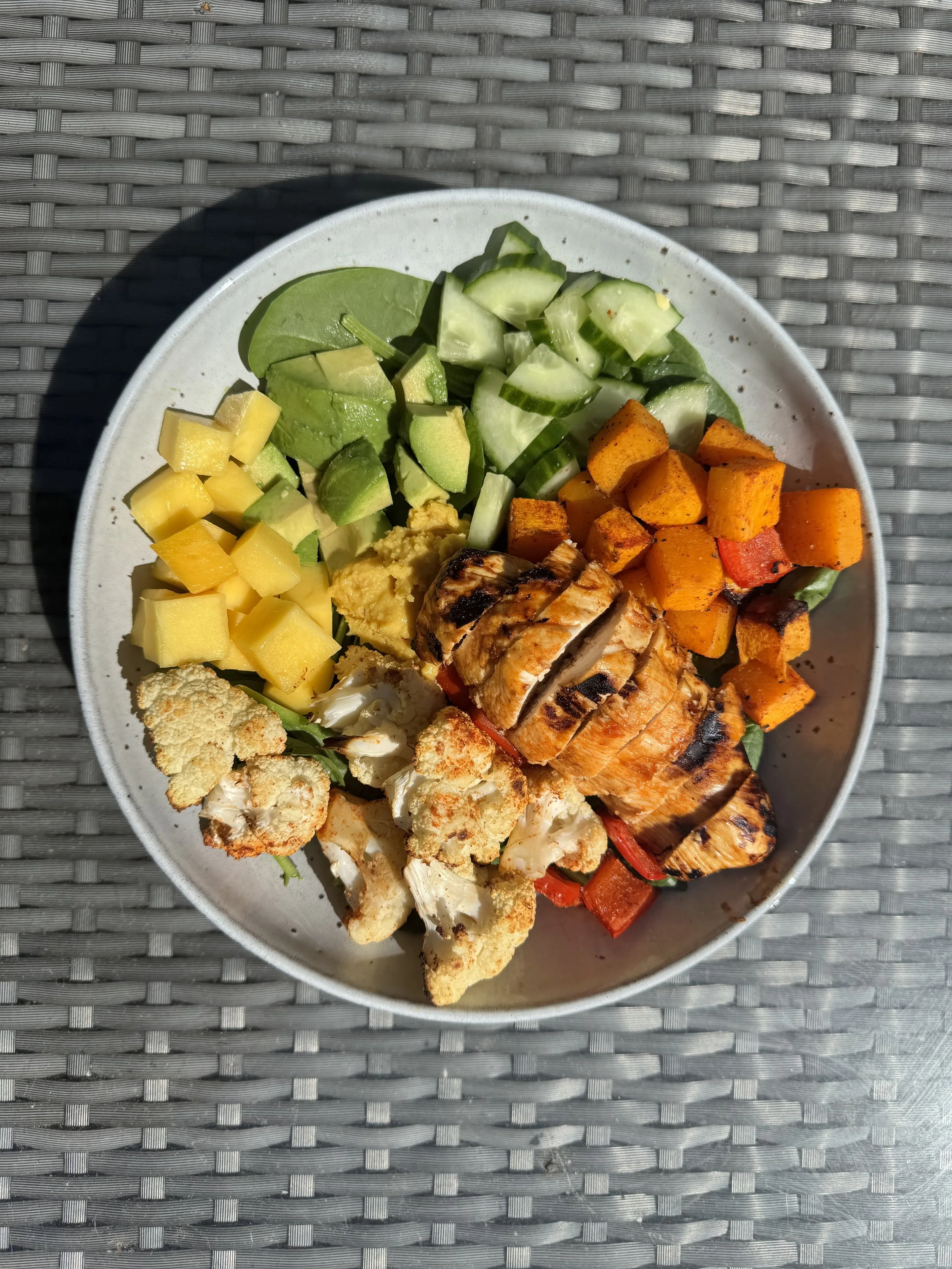
To give you an idea of how I construct a bowl, below is a lunch I threw together the other day using ingredients I had to use up in my fridge
The base of my bowl was a combination of baby spinach, along with cubes of butternut squash, florets of cauliflower and sliced red bell pepper which I roasted in a little olive oil, smoked paprika and cumin. I chose to use chicken as my protein source, marinating it for 15 minutes in ½ tsp of honey and harissa, and a squeeze of lemon juice. To add healthy fats, I cubed some leftover avocado. The rest of the toppings included where cucumbers cut into half moons, cubes of mango for sweetness, along with a spoonful of spicy mango hummus. Lastly I mixed a tbsp of jalapeño brine with the juice of half a lime. a ½ tsp of honey and dijon mustard to dress my salad with!
I hope with this post, I have provided you with a better insight as to how you can still eat salad bowls in recovery, but try and change your patterns of filling a bowl full of salad and calling it a meal. Food can still be fresh and vibrant; only a few minor tweak can transform a low energy, plain lunch into a nourishing, scrumptious meal. I encourage you to try and challenge your eating disorder, and go against your old restrictive habits by incorporating starchy carbs, oils, healthy fats and dressings into your nourish bowls. Believe me, they taste way better, and will aid you in your further rehabilitation.